Guide
How far do two-way radios actually reach?
Less far than the box claims, and the number that matters is not on the box at all. What governs range on a real event site is height, terrain and what is in the way, roughly in that order.
The headline figure
Why the box says 10km and your field says 400 metres.
Range figures on packaging are measured in conditions you will never have: two radios held high, line of sight, usually across water or from a hilltop, nothing in between. It is not quite a lie, it is just an answer to a question nobody is asking.
On a real site the honest answer is that the same pair of radios might do five kilometres across open farmland and three hundred metres in dense woodland. The radios have not changed. Everything else has.
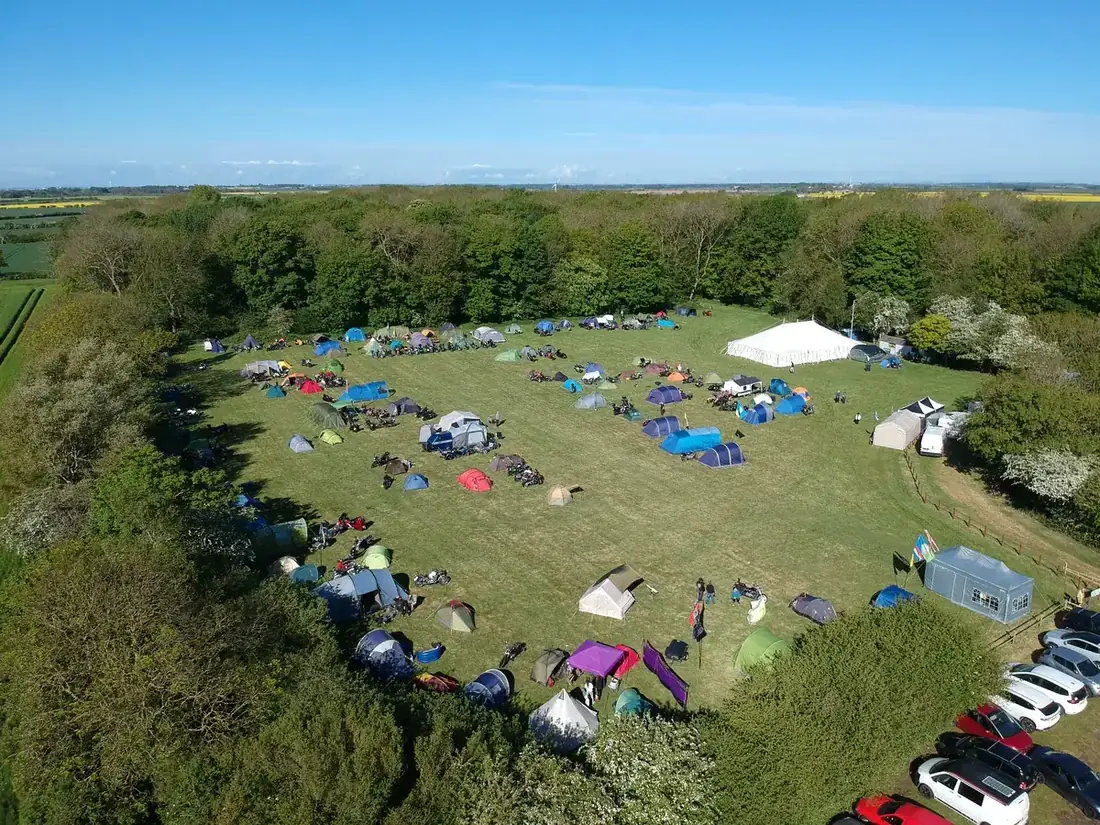
What actually determines range
- Height, more than anything else. Radio at these frequencies travels roughly line of sight. Getting an antenna up is worth more than any amount of extra power. A steward standing in a dip has a worse radio than the same steward on a gate ramp.
- What is in the way. Buildings, earth banks, hills and dense wet foliage all absorb signal. A brick wall costs you more than a hundred metres of open air. At Fortified the fort ramparts were the whole problem.
- Transmit power, but less than people think. Doubling power does not double range. It is a useful lever once height and siting are right, and close to useless before that.
- The antenna on the handset. The stubby aerial that makes a radio pocket-friendly also makes it worse at its job. This is a genuine trade and worth knowing you are making it.
- Where it is worn. A radio on a belt with the user between it and the far end loses real distance. Bodies are mostly water and water absorbs UHF.
Rough numbers, honestly caveated
Any specific figure is a lie without a site to attach it to, but as a starting point for thinking:
- Licence-free PMR446, half a watt: a few hundred metres through buildings or woodland, maybe a kilometre or two across open flat ground on a good day.
- Licensed business radio, a few watts with a better antenna: comfortably several times that in the same conditions. This is the difference people notice most.
- With a repeater on site: coverage stops being about handset-to-handset distance at all, because every radio talks to the repeater instead. On a large or awkward site this is usually the real answer.
- None of these survive contact with a specific valley, so treat them as a reason to survey rather than a substitute for one.
The question to ask instead of "how far"
Range is the wrong frame. What you actually need to know is whether every person who needs to hear a call will hear it, from wherever they will actually be standing, on the worst afternoon of your event.
That is a coverage question, not a distance one, and it has a different answer: walk the site, test from the far corners, and find the dead spots before your stewards do. It is also why we include a radio check in the build rather than handing over a box of handsets and hoping.
What to do about a site that does not cover
- Raise the antenna. Cheapest fix, biggest effect, and the one most often skipped.
- Add a repeater. One well-sited repeater usually beats any amount of fiddling with handsets.
- Go licensed. More power and cleaner frequencies, covered in the licensing guide.
- Split the problem. Sometimes the right answer is two channels and a relay point rather than one channel that nearly works.
- Accept a dead spot and plan around it. If one corner genuinely cannot be covered economically, the useful response is a procedure, not pretending it is covered.
Where this came from
We work a lot of woodland and heritage sites, which are the two environments that punish radio hardest. Bailwood is 250 people under tree cover; Fortified is inside Victorian brickwork. Those are the jobs where coverage planning stops being theoretical.
If you want this done for your site rather than estimated from a page, that is what radio hire includes.
Reading
More guides.
Ofcom Licences for Event Radios
Whether your event radios need a licence, what licence-free PMR446 actually gets you, and why hiring from a licensed supplier removes the paperwork.
Ofcom Licences for Event RadiosDoes Starlink Work at Events?
What satellite internet needs to work on a field, where it struggles, how much it realistically carries, and when 4G is the better answer.
Does Starlink Work at Events?Offering Public WiFi Safely
Filtering, logging, safeguarding and data protection in plain English. What actually matters, what is just reassuring, and what to leave alone.
Offering Public WiFi SafelyWant to know if your site covers?
Tell us the site and we will tell you what it needs, including if the answer is fewer radios than you were planning to hire.
Ask us Two-way radio hire